
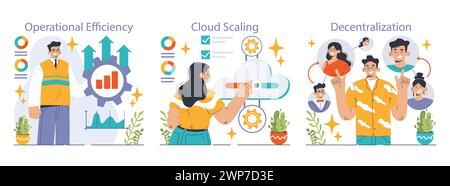
Scaling operations in the technology sector is less about simple growth and more about architecting a system that can handle exponential increases in demand, complexity, and team size without collapsing under its own weight. For CTOs, VPs of Engineering, and operations directors, the challenge is not merely adding servers or hiring more engineers—it is about preserving velocity, quality, and culture while the organization expands from a startup to an enterprise. This article provides a professional roadmap for scaling operations successfully, grounded in both technical architecture and organizational strategy.
Phase 1: The Pre-Scale Audit
Before any scaling initiative begins, a thorough audit of current operational bottlenecks is essential. Attempting to scale a broken process only amplifies inefficiencies. Focus on three core areas: observability, automation debt, and team topology.
Assessing Observability Maturity
If your engineering team requires manual debugging to identify production issues, scaling will be catastrophic. Ensure your stack includes distributed tracing, structured logging, and real-time metrics. Use a maturity model to evaluate your current state:
| 1. Reactive | Alerts fire after customer complaints | No centralized dashboards |
| 2. Proactive | Basic metrics monitored (CPU, memory) | Grafana dashboards exist |
| 3. Predictive | Anomaly detection and SLO-based alerting | SLIs defined for every service |
| 4. Autonomous | Self-healing systems and auto-remediation | Automated rollbacks in place |
Identifying Automation Debt
List every repetitive manual task in your deployment, testing, and incident response workflows. Prioritize automating those tasks that are high frequency and high risk. For example, manual database migrations during peak hours should be replaced with version-controlled migration scripts integrated into CI/CD pipelines.
Phase 2: Architectural Scalability
Successful scaling demands an architecture that is both elastic and resilient. Monolithic systems often require a transition to microservices, but this migration must be deliberate, not impulsive.
Decomposition Without Chaos
Use the Strangler Fig pattern to gradually extract bounded contexts from the monolith. Identify domains that experience the highest load variance—such as authentication or payment processing—and isolate them first. Implement circuit breakers and bulkheads to prevent cascading failures between services.
Infrastructure as Code (IaC)
Treat all infrastructure—networks, load balancers, databases—as code. Using tools like Terraform or Pulumi, version control every configuration. This practice allows you to spin up identical staging and production environments on demand, reducing configuration drift. A typical scalable stack includes:
- Compute: Auto-scaling groups with spot instances
- Data layer: Read replicas and sharded databases
- Caching: Distributed caching layers (Redis, Memcached)
- Messaging: Event-driven architecture with Kafka or RabbitMQ
Phase 3: Operational Processes at Scale
As headcount grows, informal workflows break down. Standardize processes without stifling innovation. The key is to document playbooks for routine operations while empowering teams to deviate when creativity is needed.
Incident Management Framework
Implement a severity-based incident taxonomy. For example:
After every SEV-1 and SEV-2, conduct a blameless postmortem that focuses on system improvements, not human error. Document findings in a shared repository to prevent repeat incidents.
Release Engineering
Adopt a trunk-based development model with short-lived feature flags. This allows you to deploy multiple times per day without disrupting the user experience. Combine with canary deployments and progressive delivery to roll out changes to 1% of users, monitor, then gradually increase traffic. An effective release pipeline should include:
- Automated unit and integration tests
- Security scanning (SAST/DAST)
- Performance regression checks
- Automated rollback triggers based on error budget burn rates
Phase 4: Team Organization and Culture
Scaling operations is as much a human challenge as a technical one. The most robust architecture fails if the team cannot collaborate effectively.
Moving from Teams to Squads
Transition from siloed teams (e.g., “the database team”) to cross-functional squads aligned with business domains (e.g., “checkout squad”). Each squad should own its microservices end-to-end, from development to incident response. This reduces handoffs and accelerates decision-making. Ensure every squad has a product owner, tech lead, and operations champion who advocates for reliability.
Onboarding and Knowledge Transfer
When doubling headcount, a structured onboarding program is critical. Create a “operations bootcamp” where new hires shadow on-call shifts and learn runbooks. Maintain an internal wiki with living documentation, including architecture decision records (ADRs) and dependency maps. Encourage lunch-and-learns where senior engineers share incident case studies.
Managing Cognitive Load
As systems grow, no single person can hold the entire mental model. Use “Architectural Decision Records” (ADRs) to document why certain trade-offs were made. Implement a confluence of knowledge through recorded walkthroughs and maintain a glossary of common operational terms. This reduces the cognitive burden on new hires and veterans alike.
Phase 5: Financial and Resource Governance
Scaling often comes with skyrocketing cloud costs. Implement a FinOps practice: tag all resources by team and environment, set budgets per squad, and review spending weekly. Use reserved instances for predictable workloads and spot instances for batch processing. Monitor unit economics—cost per transaction or cost per active user—to ensure growth is profitable.
A governance board that meets bi-weekly can approve or reject significant architectural changes, ensuring that scaling efforts align with both technical roadmaps and financial constraints. This board should include representatives from engineering, product, and finance.
Conclusion
Scaling operations successfully is a continuous evolution, not a one-time project. It requires balancing velocity with reliability, autonomy with standardization, and innovation with governance. By conducting pre-scale audits, adopting elastic architectures, formalizing processes, nurturing team culture, and managing costs proactively, technology leaders can build operations that not only survive growth but thrive on it. The ultimate metric of success is simple: when the next surge in demand hits, your team sleeps soundly while the system handles it gracefully.

Related Posts