
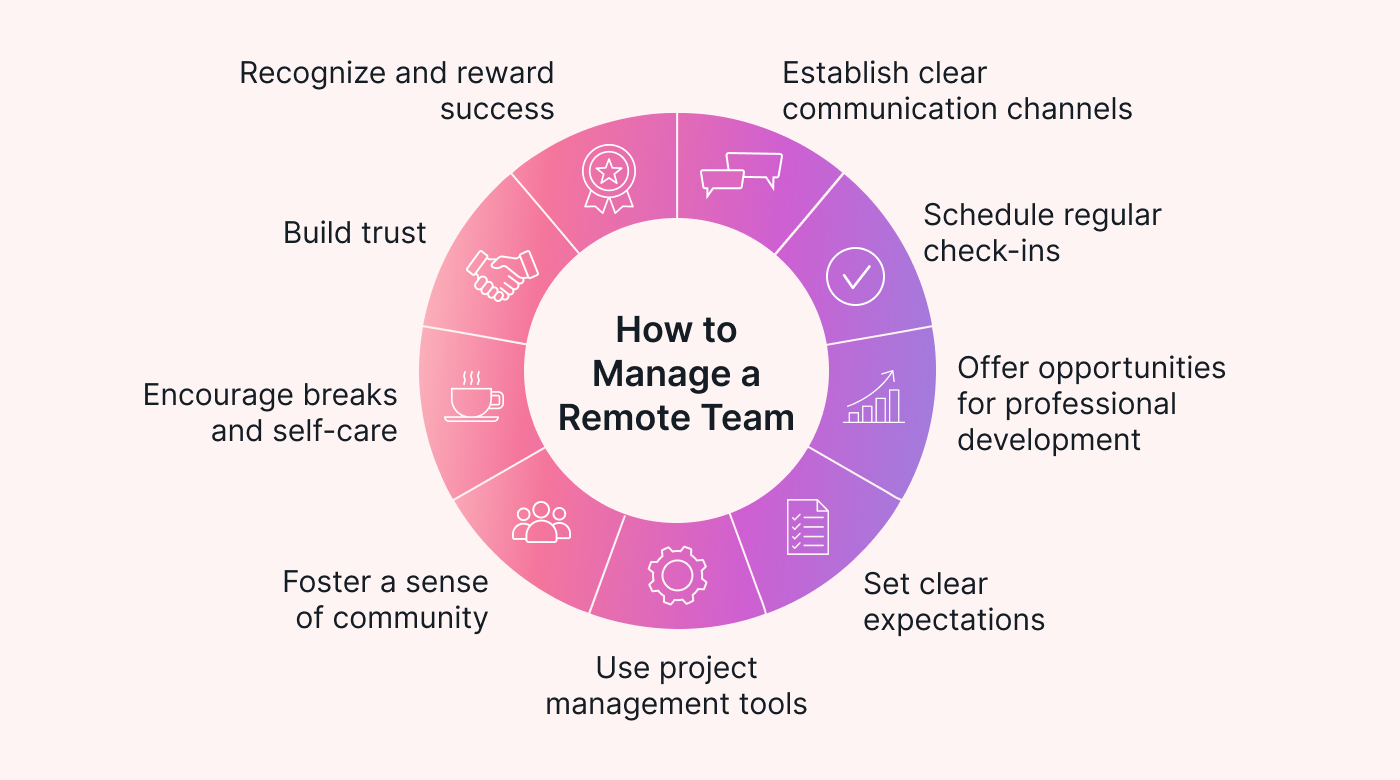
The shift to remote work has transformed the technology sector from a niche experiment into a permanent operational reality. For engineering managers, CTOs, and team leads, the challenge is no longer about enabling remote access—it is about sustaining high performance, culture, and accountability across distributed environments. This article provides a rigorous, data-informed approach to managing remote teams with precision and empathy.
The Core Pillars of Remote Team Management
Successful remote leadership rests on three foundational pillars: asynchronous communication, outcome-based accountability, and intentional culture building. Without these, even the most talented distributed teams suffer from fragmentation and burnout.
Asynchronous Communication as a Default
In a distributed team, synchronicity is a luxury. Leaders must establish written communication as the primary mode for decisions, updates, and technical documentation. This reduces meeting fatigue and ensures that team members across time zones have equal access to information. Key practices include:
- Mandatory logging of all sprint decisions in a shared wiki or document repository.
- Daily status updates in a dedicated Slack channel or similar tool, limited to 3–5 bullet points per person.
- Video recording of complex architectural decisions for later review by absent team members.
Outcome-Based Accountability Metrics
Managing by hours is toxic for remote teams. Instead, focus on delivered value using these quantitative and qualitative indicators:
| Cycle Time | Time from ticket creation to deployment | Weekly |
| Code Review Velocity | Median hours to first review feedback | Daily |
| Escalation Rate | Percentage of tasks requiring direct manager intervention | Bi-weekly |
| Employee Net Promoter Score (eNPS) | Team satisfaction and belonging index | Monthly |
These metrics remove ambiguity and promote self-management among senior engineers. For junior team members, supplement with structured 1:1 mentorship calls twice per week.
Building Trust Through Rituals and Transparency
Without physical proximity, trust erodes quickly. Counter this with ritualized transparency:
One specific tactic used by high-performing tech teams is the “weekly 20-minute standup” conducted asynchronously via text, followed by a 10-minute synchronous video window for blockers only. This respects time zones while preserving urgency.
Tools and Technology Stack Considerations
Technology is the nervous system of a remote team. However, tool proliferation is a silent productivity killer. Adopt a minimal viable stack with clear ownership:
- Messaging: Slack or Teams, with strict channel conventions (e.g., #announcements, #tech-support, #random).
- Project Management: Linear or Jira, with mandatory labels for priority and status.
- Documentation: Notion or Confluence, with a single source of truth for all standard operating procedures.
- Video Conferencing: Zoom or Google Meet, with a rule that cameras are on during 1:1s and off by default during large meetings to reduce fatigue.
Critical rule: No team should use more than three core collaboration tools. Integrate them through APIs or automation platforms like Zapier to avoid context switching.
Managing Performance and Career Growth Remotely
Remote workers often experience “out of sight, out of mind” career stagnation. To prevent this, implement a structured career development program:
Individual Growth Plans (IGPs)
Each team member, regardless of location, must have a quarterly IGP that aligns with company objectives. This includes:
- Two measurable skill goals (e.g., “Achieve AWS Solutions Architect certification” or “Lead code review for 10 PRs”).
- One cross-functional project (e.g., collaborate with the data team on a logging pipeline).
- Weekly 30-minute mentoring sessions with a senior colleague focused on career progression, not just current tasks.
Fair Performance Reviews
Remote bias is real—managers unconsciously favor visible local team members. Mitigate this by:
- Using a peer-review system with anonymous feedback from both remote and co-located peers.
- Requiring evidence-based feedback: “Sara resolved 14 customer-critical bugs this month and updated all documentation within 48 hours.”
- Conducting calibration sessions where all reviewers discuss ratings to ensure consistency across locations.
Mental Health and Burnout Prevention
The blurring of work and home life is the single greatest risk for remote tech teams. Leaders must model proactive disconnection:
- Enforce “no-meeting Fridays” or specific deep-work blocks.
- Encourage team members to log off by 6 PM local time and set Slack status to “offline” after hours.
- Provide a monthly stipend for home office ergonomics—monitors, chairs, and noise-canceling headphones.
- Conduct a weekly burnout check-in using a simple traffic light system: green (good), yellow (stressed), red (overloaded). Address reds immediately.
Remember: A burned out senior engineer is far more costly to replace than a junior one. Prevention is cheaper than recovery.
Conclusion
Managing remote teams successfully in the tech industry is not about replicating the office culture virtually. It is about designing a new system that leverages asynchronous workflows, transparent metrics, and intentional human connection. By implementing the frameworks above—structured communication, outcome-based tracking, and burnout prevention—leaders build teams that are not only productive but also resilient and deeply engaged.
The future of work is distributed. The question is not if your team will adopt these practices, but how quickly you can refine them to fit your specific technical context. Start small, measure often, and iterate relentlessly.

Related Posts